What Factors Determine Attic Insulation Installation Costs?
The cost of attic insulation installation depends on five main factors: attic size, insulation material, the R-value your climate requires,…

Most pole barn owners in Juno Beach can expect to recoup their insulation investment through reduced cooling costs and improved building longevity within 3 to 8 years, with ongoing savings accumulating well beyond the payback period. The EPA estimates that air sealing and adding insulation yields an average of 9% savings on heating and cooling costs in Climate Zone 2, which covers South Florida, where Juno Beach is located. Because pole barns have large, exposed metal surfaces with minimal built-in insulation, the actual percentage of savings often exceeds this average, especially when the building is actively climate-controlled year-round. The type of insulation material, the building’s use, and the quality of installation all influence the final ROI. Choosing the right pole barn insulation system can make a significant difference in long-term energy performance.
Juno Beach experiences a tropical rainforest climate with hot, humid summers and no true dry season. Average daily highs from June through September sit between 89 and 91 degrees Fahrenheit, with overnight lows rarely dipping below 75. Annual precipitation exceeds 72 inches, and humidity remains elevated year-round. For a pole barn, this combination of heat and moisture creates an environment where uninsulated metal roofing and walls radiate heat inward during the day while condensation forms underneath during cooler nighttime hours. Pole barn insulation savings in Juno Beach can be significant when these issues are addressed with the right system.
Pole barns, by design, are single-skin metal structures with wood or steel framing. Without insulation, the metal skin transfers heat almost instantly. During a Juno Beach summer afternoon, interior temperatures can easily run 15 to 25 degrees higher than the outside air because of radiant heat gain through the roof. That means an uninsulated pole barn being used as a workshop, storage space, or agricultural facility can become essentially unusable during peak heat without massive air conditioning output.
The EPA’s Seal and Insulate with ENERGY STAR program notes that most buildings in the United States are under-insulated, and that proper sealing and insulation can save homeowners up to 10% on annual energy bills. In Juno Beach’s specific climate zone, the savings on cooling alone are especially meaningful given the extended cooling season that runs roughly 8 to 10 months of the year.
The return from insulating a pole barn comes from three distinct value streams: energy savings, damage prevention, and functional usability.
Energy savings is the most straightforward. When your HVAC system does not have to fight against radiant heat pouring through bare metal panels, it runs shorter cycles and consumes less electricity. The EPA’s detailed methodology for estimating savings breaks down expected returns by climate zone. In Climate Zone 2, the modeled savings are 9% on heating and cooling alone and 6% on total energy costs. For a pole barn running a dedicated AC unit, the percentage can be significantly higher because the baseline energy use of an uninsulated metal building is so much worse than a typical wood-frame home.
Damage prevention is an often-overlooked ROI factor. Condensation on metal surfaces inside an uninsulated pole barn leads to rust on structural fasteners, rot on wood framing, mold on stored contents, and deterioration of equipment. Repairing or replacing structural damage from long-term moisture exposure can cost multiples of what insulation would have cost. Closed-cell spray foam, which doubles as a vapor barrier, eliminates this condensation cycle by keeping warm, humid air away from cold metal surfaces.
Functional usability may not show up on a utility bill, but it has real economic value. A pole barn that maintains a comfortable interior temperature can be used as a workshop, office, hobby space, or equipment storage year-round, rather than sitting empty during summer months. That expanded usability translates directly into the building owner’s ability to use an asset they have already invested in.
Different insulation materials perform very differently in a hot, humid Florida environment. The table below compares the most common options for pole barns in Juno Beach.
| Insulation Type | R-Value Per Inch | Vapor Barrier | Best For | Expected Lifespan | Ideal Juno Beach Use |
|---|---|---|---|---|---|
| Closed-cell spray foam | R-6 to R-7 | Yes | Full climate control, moisture-prone buildings | 25+ years | Workshops, offices, climate-controlled storage |
| Open-cell spray foam | R-3.5 to R-3.7 | No (needs separate barrier) | Budget-friendly air sealing | 20+ years | Hobby barns, shelters with no HVAC |
| Fiberglass batts | R-2.9 to R-3.8 | No | Dry, conditioned spaces only | 15-20 years | Finished interior spaces with vapor barrier added |
| Reflective/radiant barrier | Low | No | Reducing radiant heat gain only | 10-15 years | Storage barns where full insulation is not needed |
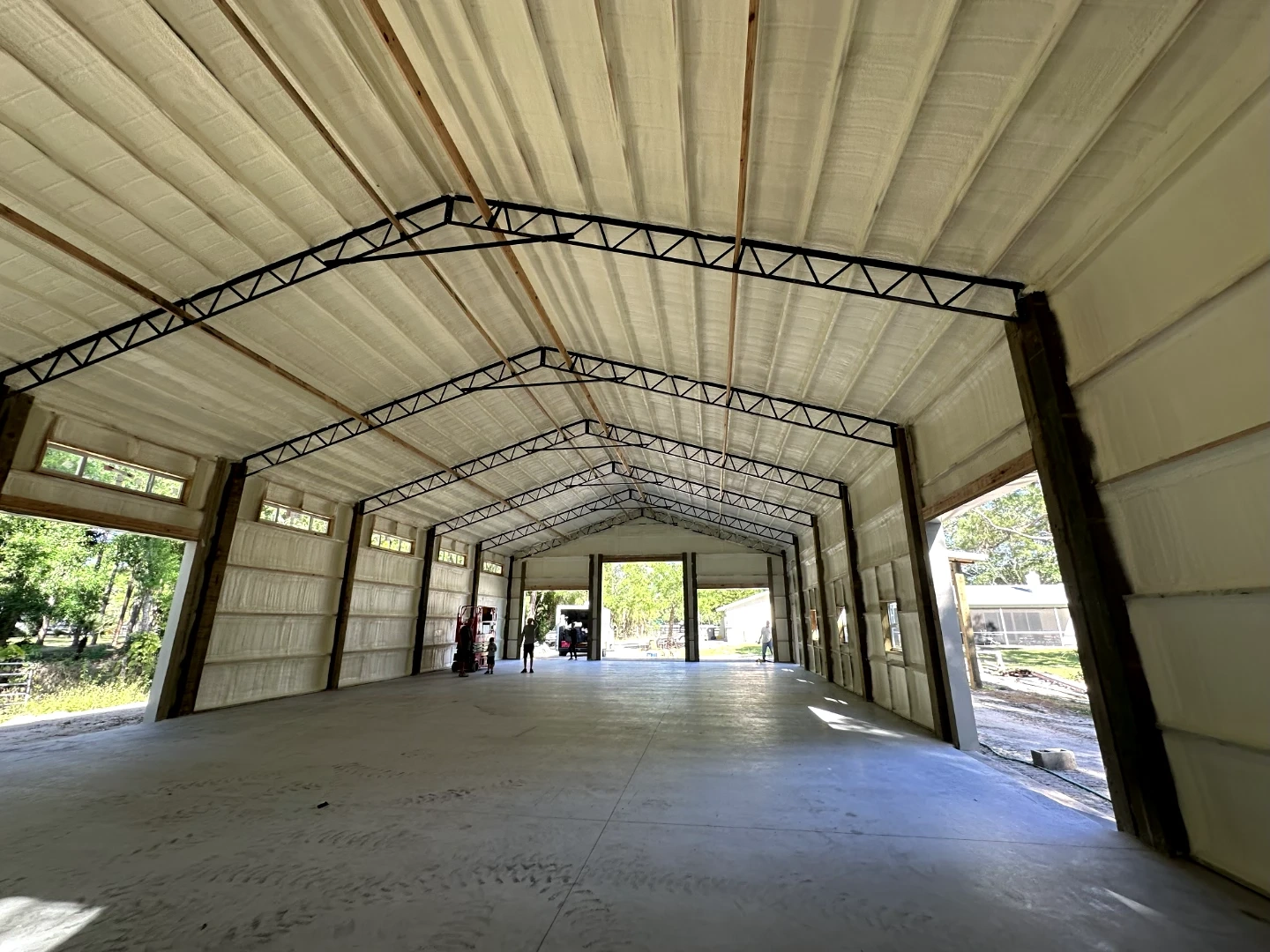
Closed-cell spray foam stands out as the top performer for Juno Beach pole barns. It delivers the highest R-value per inch, acts as a vapor retardant, seals air leaks on contact, and adheres directly to the metal substrate. According to the Insulation Outlook Magazine published by the National Insulation Association, energy efficiency investments like insulation function as “permanent cost reductions” and their real value becomes apparent when analyzed over the full 25-year life cycle rather than just the initial payback period.
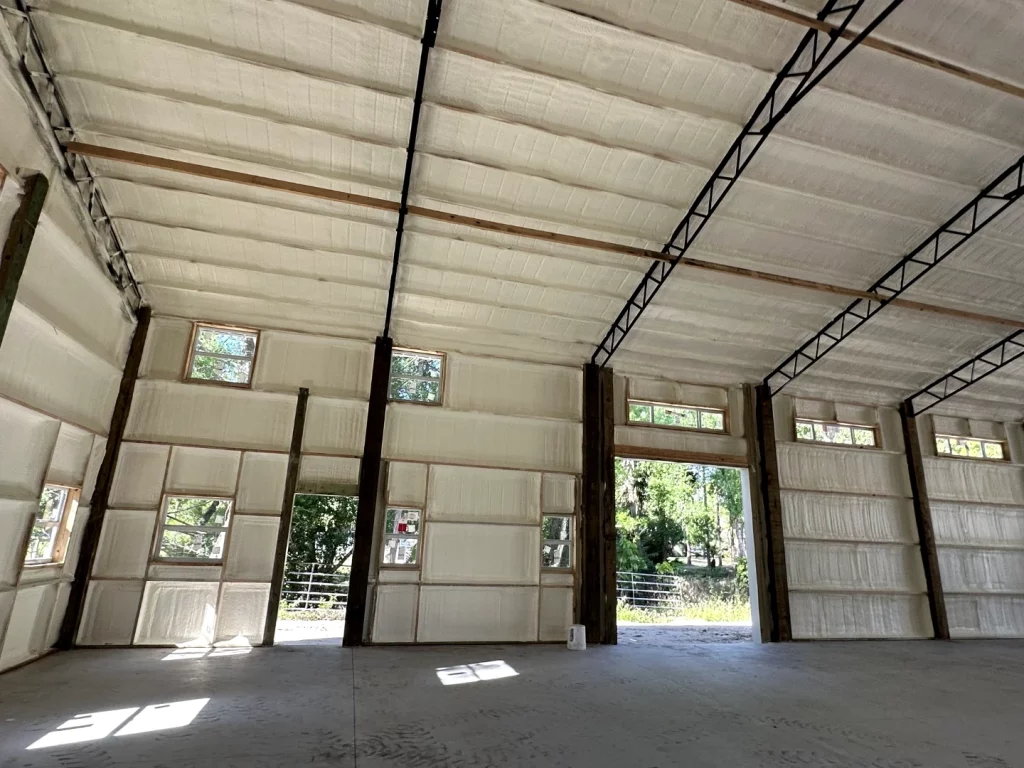
Several variables determine how quickly you will see a return on your insulation investment.
Building size and usage. A pole barn used daily as a workshop with a dedicated HVAC unit will show faster energy savings than one used occasionally for storage. Larger buildings require more insulation material upfront, but they also generate proportionally larger energy savings once conditioned.
Existing conditions. If your pole barn already has failing or damaged insulation that needs removal, the initial investment increases, but the improvement in performance after replacement is also more dramatic. Our pricing data shows that removal of old insulation is one of the most common factors that add to project cost.
Insulation material. As the comparison table shows, closed-cell spray foam carries a higher upfront cost than fiberglass or radiant barriers, but it eliminates the need for a separate vapor barrier and delivers superior performance per inch. In a humid climate like Juno Beach’s, skipping the vapor barrier with cheaper materials often leads to moisture problems that eat into long-term savings.
Ductwork condition. If your pole barn has ductwork running through uninsulated spaces, leaky ducts can reduce heating and cooling efficiency by as much as 20%, according to ENERGY STAR’s duct sealing research. Sealing and insulating ducts alongside the building envelope compounds the savings.
Orientation and shading. A pole barn with a large south-facing or west-facing metal roof will experience more radiant heat gain, making insulation even more impactful. Buildings shaded by trees or adjacent structures may see slightly lower but still meaningful savings.
The right insulation approach depends on how you use your pole barn.
Climate-controlled workshop or office. Closed-cell spray foam is the clear recommendation. The vapor barrier properties protect against Juno Beach’s humidity, the high R-value keeps cooling costs manageable, and the air-sealing qualities prevent conditioned air from escaping through gaps around framing members. Working with a spray foam insulation contractor in Juno Beach, FL ensures these performance benefits are achieved through proper installation.
Agricultural or equestrian storage. For buildings that need temperature moderation but not full climate control, open-cell spray foam or fiberglass with a separate vapor barrier can work. The priority here is preventing condensation that could damage feed, tack, or equipment, while keeping interior temperatures closer to outdoor ambient levels.
Seasonal or occasional use. A reflective radiant barrier combined with ventilation may provide enough improvement for a pole barn used only a few hours per week. This approach reduces radiant heat gain at lower cost, though it will not match the performance of foam insulation for temperature control.
Choosing the right insulation strategy for your Juno Beach pole barn is easier when you know what quality looks like. A strong approach will include a thorough assessment of your building’s current condition, including existing insulation, air leakage points, and moisture issues. The provider should explain why a specific material is recommended for your building’s use case rather than pushing a one-size-fits-all solution. Clear communication about thickness targets, R-value goals, and vapor barrier needs is essential in Florida’s humid climate. You should receive a detailed scope of work with transparent pricing that accounts for factors like square footage, access difficulty, and whether removal of existing materials is required. Finally, the right approach accounts for long-term performance, not just the initial cost, recognizing that insulation is a 25-year-plus investment in your building.
Our team at All In OverHall specializes in pole barn insulation throughout the Juno Beach area, and we understand the specific challenges that Florida’s heat and humidity create for metal buildings. We take the time to evaluate your building’s current condition, discuss your goals for the space, and recommend the insulation approach that delivers the best long-term return for your situation.
Request a Quote | Schedule an On-Site Assessment
Reach us at (561) 406-3835 or [email protected] to get started. We are ready to help you turn your pole barn into a comfortable, efficient, and protected space that pays for itself year after year.
Yes. Even without active cooling, insulation dramatically reduces interior temperatures and prevents condensation from forming on metal surfaces, which protects stored items from moisture damage and rust.
Spray foam insulation, when properly installed, lasts 25 years or more. Fiberglass can last 15 to 20 years, but is more susceptible to moisture damage in humid climates if a proper vapor barrier is not in place.
Insulating the roof provides the most significant impact on radiant heat gain, but insulating both roof and walls delivers the best overall temperature control and condensation prevention, especially in Juno Beach’s humid climate.
Closed-cell spray foam acts as both a thermal barrier and a vapor barrier, preventing warm, humid outdoor air from reaching cooler metal surfaces where condensation would otherwise form.
Most pole barn owners see a noticeable reduction in cooling costs, with the EPA estimating 9% savings on heating and cooling in Climate Zone 2. The actual savings for a metal building with no existing insulation are often higher than this average.